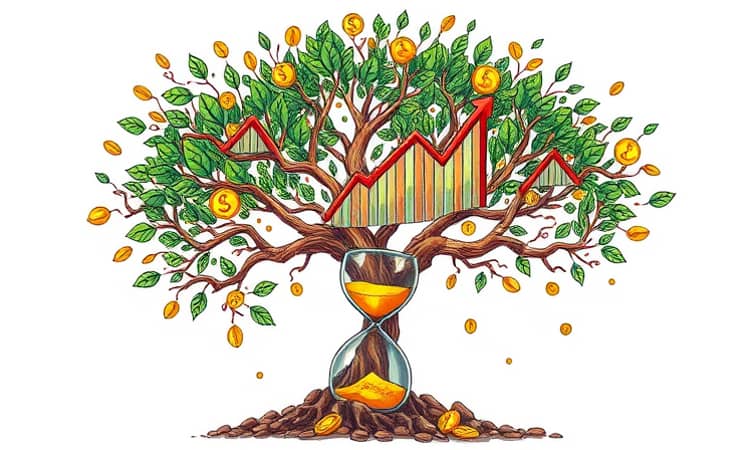
Compounding is often portrayed as a dry formula in textbooks, but its real power extends far beyond basic interest calculations. When harnessed wisely, the mechanism of “interest on interest” becomes an engine for transformative financial growth.
In this deep dive, we will explore core definitions, numeric examples, and real-world applications of compounding. You’ll discover practical strategies to leverage exponential growth, understand the risks of magnified debt, and learn how to apply the art of compounding in diverse investment vehicles.
Simple Interest vs Compound Interest
At its heart, compound interest multiplies your returns by paying interest not only on the original principal but also on all accumulated interest from prior periods. In contrast, simple interest calculates returns solely on the initial principal, producing linear growth.
The formulas are straightforward:
Simple interest: principal (P) × annual rate (r) × time in years (t).
Compound interest: future value (A) = P × (1 + r/n)^(n × t), where n is the number of compounding intervals per year.
- Simple interest: interest calculated on original principal only
- Compound interest: interest calculated on principal plus accumulated interest
This fundamental difference—whether interest itself earns interest—drives exponential versus linear growth, a distinction that becomes profound over time.
Numeric Illustrations: Seeing Exponential Growth
Concrete examples bring compounding to life. Consider an investment of $10,000 at a 5% annual rate over three years. Under simple interest, you earn exactly $1,500, for a final balance of $11,500.
Under annual compounding, however, the balance grows to $11,576.25. That extra $76.25 represents interest on interest in action, earned in the second and third years.
Change the rate or compounding frequency and the gap widens. At a 4% rate for three years, simple interest yields $1,200 versus compound interest of about $1,248.64.
Even more striking, monthly compounding at 5% pushes the final amount to $11,618.62—an additional $42.37 earned purely by increasing the compounding frequency.
The Power of Time: Long-Horizon Compounding
Time is the greatest ally of compound growth. Over short intervals, the difference between simple and compound may appear modest, but it multiplies dramatically over decades.
Take a $6,000 starting balance at 5% annual rate. After 10 years, simple interest produces $8,100, while compounding yields $8,464. After 30 years, simple interest grows to $12,300, but compounding soars to roughly $16,840—an extra $4,540 from long-term exponential growth.
Investors often use the “Rule of 72” as a mental shortcut: divide 72 by the annual rate to estimate how many years it takes to double your money. At 6%, for example, 72/6 ≈ 12 years to double under compound returns, not 100% divided by 6% equals 16.7 years under simple addition.
Compounding Beyond Savings
Compounding appears in more than just savings accounts. Widely used investment vehicles and strategies harness reinvested earnings to amplify returns over time:
- Dividend Reinvestment Plans (DRIPs): automatically reinvest dividends to buy additional shares
- Mutual funds, index funds, and ETFs: capital gains and dividends are often reinvested
- Bonds with reinvested coupons: coupon payments are used to purchase more bonds or similar assets
Each mechanism relies on the same principle: by keeping all earnings at work, you continuously expand your compounding base and accelerate growth.
Compounded Returns vs Average Annual Returns
In equity and fund performance analysis, the Compound Annual Growth Rate (CAGR) captures the true annualized return including compounding. Unlike a simple arithmetic average of yearly returns, CAGR tells you the steady growth rate that would take your starting value to the ending value over a specified period.
For instance, a series of returns of +20%, –10%, +15% does not average out to (20 – 10 + 15)/3 = 8.33% in terms of wealth growth. Instead, the actual compounded return may be closer to 7.9%, reflecting that losses reduce your base for subsequent gains.
Managing the Double-Edged Sword of Debt
Compounding can work against you when you borrow. Credit card balances and many consumer loans compound interest on unpaid amounts—interest accrues on top of interest, rapidly snowballing debt.
High rates combined with daily or monthly compounding can turn small outstanding balances into unmanageable obligations, illustrating how the same exponential mechanics that build wealth can also magnify financial stress.
Always compare borrowing costs by accounting for compounding frequency, and aim for simple interest loans when possible if you must borrow.
Key Levers That Amplify Compounding Effects
Investors and savers can enhance compounding outcomes by focusing on a few fundamental levers:
- Longer investment duration
- Regular reinvestment of all earnings
- Higher compounding frequency (e.g., monthly instead of annually)
By optimizing these factors, even modest contributions can grow into substantial sums over decades, turning disciplined saving into financial freedom.
Ultimately, the art of compounding lies in patience, consistency, and an understanding of exponential dynamics. Whether you are building a retirement nest egg, reinvesting dividends, or paying down debt, respect the power of compounding—it can be your greatest ally or your steepest challenge.