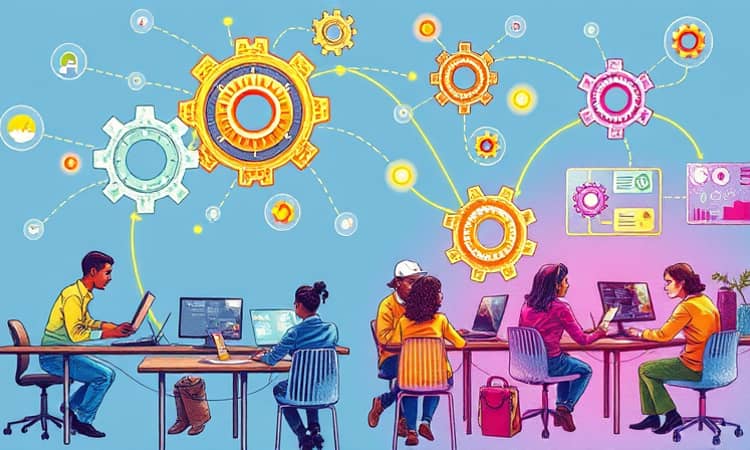
Every organization aspires to build a lasting competitive edge, yet the journey from aspiration to achievement often remains obscured by broad-stroke strategies and high-level frameworks. Beneath the surface of grand business models and corporate declarations lies a tapestry of choices, actions, and interactions performed by individuals every day. By exploring the aggregated individual behaviors and interactions that generate firm-level strengths, leaders can illuminate the hidden pathways that lead from individual effort to organizational excellence.
In a dynamic economic landscape defined by rapid technological change and shifting customer demands, firms can no longer rely solely on static resources or legacy routines. Instead, they must intentionally develop the building blocks of resilience, innovation, and agility at the individual and team levels. This article offers a roadmap to understanding and harnessing microfoundations—crafted routines and practices that drive emergence—to transform individual capabilities into enduring organizational performance.
From Individuals to Capabilities: Mapping the Journey
Microfoundational research challenges us to trace a line from the individual level through routines and processes to firm-level outcomes. At the micro level, employees bring distinct skills, knowledge, motivations, and cognitive perspectives to the table. As they interact in dyads, teams, and networks, those individual attributes coalesce into shared practices and routines. Over time, these routines solidify into organizational capabilities—higher-order abilities like strategic agility, innovation prowess, and operational resilience.
To maintain clarity amid complexity, consider three core transitions:
- Individual Attributes → Team Interactions: How personal expertise and motivation shape collaboration dynamics.
- Team Interactions → Established Routines: How repeated interactions embed patterns of coordinated action.
- Routines → Emergent Capabilities: How stabilized routines give rise to emergent organizational capabilities and strengths that power firm performance.
Debunking Common Misconceptions
As the microfoundations perspective gains traction across strategy and organizational research, several half-truths have surfaced. Clarifying these misconceptions is essential for scholars and practitioners committed to rigorous application:
- “Microfoundations = psychology.” True, the approach draws on individual cognition and behavior, but it demands clear causal chains linking micro to macro rather than a mere transplant of psychological constructs.
- “Borrow any micro variable.” Contrary to this belief, valid microfoundations require more than borrowing; they need explicit mapping of how those variables aggregate into firm-level phenomena.
- “Infinite regress problem.” While tempting to drill down endlessly, researchers can stop at the level that most directly influences organizational outcomes, ensuring focus and tractability.
- “Ignores structure and institutions.” In fact, microfoundations integrate structures, routines, and contextual factors as essential components in shaping individual actions and emergent properties.
Core Building Blocks of Company Strength
With misconceptions addressed, we turn to the foundational elements that underpin company strength. These elements operate at different levels of analysis:
Understanding the patterns of coordinated behavior that stabilize at the meso level is vital for deliberate capability-building. Whether launching a new product development routine or codifying conflict resolution practices, firms embed micro-level behaviors into stable organizational assets.
Across the literature, five recurring microfoundational mechanisms emerge as pillars of organizational strength:
- Learning and cognition: Individual and team sensemaking, absorptive capacity, and knowledge sharing.
- Motivation and engagement: Psychological safety, intrinsic motivation, and discretionary effort.
- Social networks and ties: Collaboration networks, boundary-spanning roles, and trust.
- Leadership micro-behaviors: Coaching, feedback, framing, and role modeling in daily interactions.
- Individual-level absorptive capacity: Recognizing, assimilating, and applying external knowledge.
Bringing Microfoundations to Life: Practical Steps
Translating microfoundational theory into organizational practice requires intentional design, measurement, and iteration. Leaders must align HRM practices, leadership development, and process engineering around identified microfoundational mechanisms. The following steps provide a structured path forward:
- Define key capabilities: Identify the specific firm-level strengths (e.g., innovation, agility) that align with strategic priorities.
- Diagnose micro mechanisms: Map out which individual behaviors, team interactions, and routines currently support—or impede—those capabilities.
- Design interventions: Craft targeted training programs, incentive systems, and structural supports to deliberately cultivate microfoundational mechanisms.
- Measure and adapt: Establish metrics at multiple levels (individual performance, team routines, capability outcomes) and iterate based on data-driven insights.
- Embed continuous learning: Foster a culture where experimentation, feedback, and reflection reinforce and evolve microfoundations over time.
Consider the example of a mid-size manufacturing firm aiming to boost its dynamic capabilities in digital transformation. By auditing front-line teams’ digital literacy (micro), redesigning cross-functional stand-up meetings (meso), and tracking adaptive project completion rates (macro), the firm created a feedback loop that accelerated technology adoption and reconfiguration.
Similarly, a software startup seeking to elevate its innovation capability established informal “innovation huddles” where engineers, designers, and product managers rotated weekly, sharing insights and rapid prototypes. This simple micro intervention fostered a powerful emergent capability: accelerated experimentation and idea refinement, concretely impacting time-to-market performance.
Ultimately, microfoundations remind us that companies do not succeed by decree or by chance alone; they succeed through the intentional orchestration of individual actions, interactions, and routines that accumulate into something greater than the sum of their parts. By embracing this perspective, leaders can open the black box of organizational capabilities and engineer a future-ready firm.
In the story of every transformational enterprise, the true driving force is human: individuals who learn, connect, and adapt day after day. When those human elements are understood, nurtured, and aligned, emergent competitive advantages take shape, charting a course from small-group interactions to firm-level triumphs. It is within this intricate web of microfoundations that the seeds of innovation, resilience, and sustained performance are truly sown.