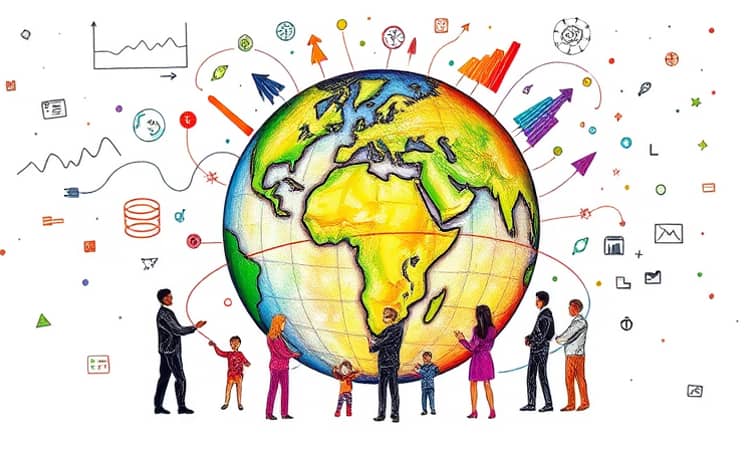
In an era of unprecedented change, understanding the forces at play and cultivating adaptive strategies is essential. As 2026 approaches, nations and businesses face a landscape marked by restraint and opportunity alike. This article offers a comprehensive guide to navigating the coming economic currents with clarity and purpose.
The Global Growth Outlook
Projections for 2026 suggest global growth is projected to slow, with estimates ranging from 2.7% to 3.3%. While these figures remain below the pre-pandemic average, they reflect a degree of resilience amid persistent headwinds. For context, the United States may expand by 1.8%, Europe by 1.3%, and Asia by 4.5%. Each region confronts distinct challenges, from trade barriers to demographic shifts.
Inflation trends offer both relief and concern. Headline rates are forecast to settle around 3.1%, down from 3.4% in 2025. Yet cost-of-living pressures linger in essentials like food, energy, and housing. Policymakers must balance price stability with growth support, while households adjust to evolving budgets under differing national circumstances.
Geopolitical Fragmentation and Trade Paradoxes
The reordering of globalization has profound implications. We face a world of fragmented alliances and geo-economics, with the US and China contending over technology, rare earths, and strategic investment. Tariffs, export controls, and regional pacts are reshaping supply chains and trade flows.
Paradoxically, the United States remains both a stabilizing presence and a source of uncertainty. Tariff rates have stabilized between 14.5% and 16%, up from historic lows. Europe, Japan, and other allies seek alternative linkages—via ASEAN, Canada, and Australia—to mitigate risk, underscoring the rise of new trade corridors.
Fiscal Constraints and Policy Dilemmas
Fiscal space has narrowed across many advanced economies. Government deficits are ballooning: the US faces a $1.9 trillion gap in FY2026, projected to exceed $3 trillion by 2036. Public debt ratios could reach 143% of GDP by 2030. In Europe, France teeters on a fiscal precipice reminiscent of Italy, while Spain works to bring deficits below 2.5%.
Developing nations also grapple with tight budgets. Colombia’s deficit hovers above 7% of GDP, prompting tax reforms to raise revenues equivalent to 1.5% of economic output. Across regions, leaders confront a difficult trade-off: fiscal consolidation versus growth support, where higher taxes or spending cuts risk dampening private demand.
The AI and Innovation Boom
Amid fiscal constraints and trade frictions, technology emerges as a powerful growth lever. Big tech firms are on track to invest nearly $3 trillion in AI by 2030—almost 10% of US GDP. In the first half of 2025, these investments drove 90% of US GDP growth, fueled by data centers, hardware, and software innovation.
Yet questions remain about medium-term profit sustainability. Highly leveraged financing and complex cross-holdings could temper returns. To harness AI’s full potential, societies must support displaced workers, foster reskilling programs, and ensure fair tax regimes that capture gains without stifling innovation.
Regional Spotlights and Economic Risks
A closer look at specific regions underscores the diversity of challenges and opportunities unfolding in 2026.
Broader Megatrends and Global Risks
Looking beyond 2026, we face a tapestry of megatrends. The World Economic Forum warns of geopolitical shocks and rapid tech change, while climate volatility and social unrest loom large. Talent shortages and migration dynamics are redefining labor markets, giving rise to a “trust economy” where reputation and data integrity become monetizable assets.
As markets price in high valuations and central banks juggle inflation targets, the probability of recession hovers near 35%. Developing countries remain especially vulnerable to debt distress and climate-driven shocks, emphasizing the need for agile policy coordination.
Strategies for Preparation and Transition
Success in 2026 hinges on foresight, flexibility, and cooperation. The following principles can guide governments, businesses, and individuals through uncertainty:
- Stress-test core assumptions and develop flexible scenarios underpinned by data-driven foresight.
- Balance fiscal discipline with targeted investments in infrastructure, energy transition, and human capital.
- Foster multilateral cooperation to secure supply chains, mitigate climate risks, and support developing economies.
Organizations should also invest in proprietary migration pipelines and reskilling programs to address talent gaps. Public–private partnerships can drive innovation clusters in AI, semiconductors, and green technology, creating jobs and enhancing global competitiveness.
Individuals, meanwhile, can build resilient career paths by embracing lifelong learning, diversifying skills, and cultivating digital literacy. Trustworthiness and adaptability will be as valuable as technical expertise in the emerging labor landscape.
Conclusion
The economic horizon for 2026 is neither predetermined nor bleak. By understanding core projections, anticipating geopolitical shifts, and embracing innovation, stakeholders can turn challenges into opportunities. Resilient strategies and collaborative action will pave the way for sustainable growth, shared prosperity, and a future that reflects our highest aspirations.