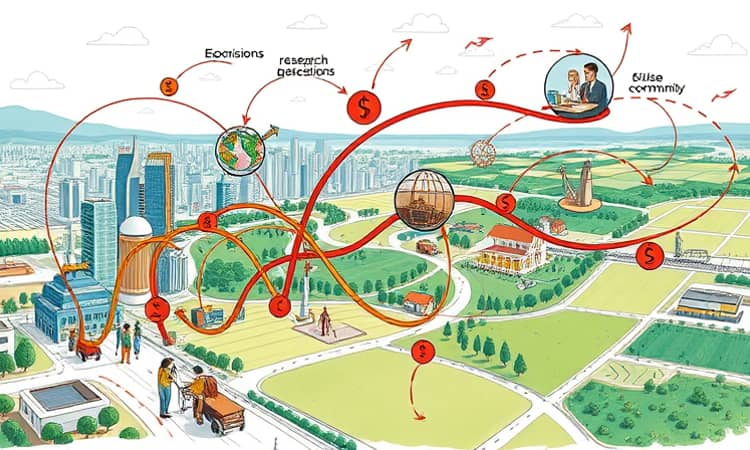
In an era where every corporate choice resonates far beyond the boardroom, understanding traceable economic, financial, and sustainability impacts has become essential. Organizations today must look past traditional accounting measures to capture the full spectrum of consequences their operations generate. This comprehensive perspective helps leaders make informed decisions that benefit shareholders, communities, and the planet.
By mapping how expenditures, investments, and disruptions influence local economies, social wellbeing, and environmental health, businesses can align strategy with global sustainability goals. Below, we explore the core concepts, practical methods, and inspiring examples that bring financial footprints into sharper focus.
Understanding Financial Footprints
Financial footprints encompass the direct, indirect, and induced effects of decisions on the economy, society, and environment. They extend beyond simple profit-and-loss statements to include contributions to GDP, employment generation, and research and development.
Key categories of footprints include:
- Economic Footprint: Contribution to national GDP via Gross Value Added (GVA), employment, and labor productivity.
- Personal Financial Footprint: The trail of debts, credit history, and investments shaping individual legacy and access for heirs.
- Environmental/Product Footprint: Greenhouse gas emissions, resource consumption, and lifecycle impacts from raw material sourcing to disposal.
- Social and Poverty Footprint: Workforce diversity, occupational health, poverty alleviation, and empowerment measures.
- Business Impact Analysis (BIA): Assessment of disruption costs, recovery objectives, and operational resilience.
The Triple Bottom Line in Practice
John Elkington’s triple bottom line framework underscores that sustainable success requires balanced pursuit of economic, social, and environmental goals. Financial footprints serve as measurable pillars of each dimension:
• Economic: Salaries and taxes boost local spending, supplier networks generate additional output, and employee expenditure induces further growth.
• Social: Fair labor practices, diversity initiatives, and poverty alleviation programs strengthen community resilience and brand reputation.
• Environmental: Carbon tracking across operations and product lifecycles informs mitigation strategies to reduce ecological risk.
R&D intensity, viewed as investment in intellectual property for long-term growth, epitomizes how innovative activities drive future economic and social benefits.
Real-World Case Studies
Illustrative examples demonstrate the power of financial footprints:
Graphene Flagship Project (2014–2030) mapped GVA and job creation across Europe, quantifying how R&D investments ripple through economy and research networks. This case highlights the value of holistic value chain tracing for policymakers and stakeholders.
An electronics manufacturer compared its factory energy use with the device lifecycle emissions. Misaligned efforts initially drove up costs and penalties until a coordinated strategy cut both operational and product footprints by 20%, boosting profit margins and sustainability credentials.
A headphone producer’s use of recycled plastics and batteries revealed hidden environmental trade-offs. Without proper footprint analysis, the company risked fines and reputational damage. By realigning procurement and design, it achieved circularity goals and captured eco-conscious market share.
Mitigating Risks and Maximizing Opportunities
Poorly assessed footprints expose organizations to financial, environmental, and reputational harm. Key risks include:
- Increased Operating Costs: Inefficient resource use and missed savings.
- Regulatory Penalties: Non-compliance with emissions and labor standards.
- Reputational Damage: Loss of stakeholder trust and market share.
- Strategic Shortfalls: Failure to innovate or respond to disruptions.
A structured BIA process helps preempt losses and improve resilience. Essential steps involve:
- Identifying critical functions and dependencies.
- Assessing potential impacts across all dimensions.
- Defining recovery time objectives (RTOs) for rapid restoration.
- Implementing mitigation plans to safeguard continuity.
Integrating Footprints into Decision-Making
Embedding financial footprint analysis within corporate governance transforms decision-making. Organizations can establish transparency and comparability by adopting standardized metrics aligned with the UN Sustainable Development Goals and emerging ESG frameworks.
Benefits of integration include:
- Evidence-based stakeholder engagement and reporting.
- Risk mitigation for natural disasters, cyber threats, and supply chain disruptions.
- Data-driven sustainability KPIs that drive accountability.
- Innovation opportunities through holistic resource optimization.
When businesses embrace the full scope of their financial footprints—from GDP contributions to carbon tracking—they unlock new pathways to competitive advantage and societal impact. By weaving together economic, social, and environmental considerations, leaders can chart a course toward sustainable prosperity that resonates across generations.
Ultimately, financial footprints are more than metrics; they are a narrative of an organization’s role in shaping the world. By measuring, analyzing, and acting on these footprints, we ensure that each choice propels us toward a resilient, equitable, and thriving future.