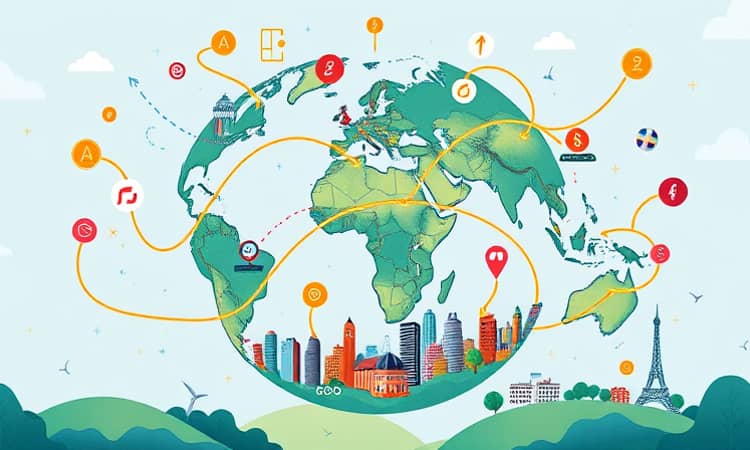
Global economic rhythms no longer play out far from home—they reverberate through every household, every business, and every financial ledger. Understanding these echoes is essential to building resilient communities.
Global Growth Outlook and Local Ripples
The world economy is projected to expand at just 2.7–3.3% in 2026, trailing its pre-pandemic average of 3.2%. While Asia emerges as a growth bright spot, regions like the Eurozone and North America face headwinds. Local economies feel these headwinds through channel after channel, from price pressures to investment slowdowns.
Trade tensions and geopolitical uncertainties are chief among these headwinds. Escalating US tariffs, rising defense budgets, and commodity volatility inject volatility into global supply chains. For households, this translates into higher food, energy, and import prices; for firms, into postponed investment and altered production plans.
- US tariffs on imports reshuffle nearshoring trends, delaying investment decisions in Canada and Mexico.
- Geopolitical disruptions amplify commodity price spikes, squeezing consumer purchasing power worldwide.
- Technological competition in AI and semiconductors drives sharp divergences, with Asia leading and Europe lagging.
Key Mechanisms of Transmission
How exactly do distant policy shifts and global shocks filter down to Main Street? Four key mechanisms stand out:
- Subdued investment and consumer spending as firms delay capital outlays and households tighten budgets in response to uncertainty.
- Inflation dynamics: uneven disinflation in advanced economies, with food and energy costs remaining persistent.
- Labor market shifts: immigration curbs in the US tighten labor supply, while automation and AI investments reshape job profiles.
- Fiscal strains: elevated debt levels limit governments’ ability to respond with large-scale stimulus.
These mechanisms often interact, locking some regions into a low-growth equilibrium. Without strategic fiscal coordination across borders, countries face a patchwork of policy responses that may cancel each other out.
Local Impacts on Households, Businesses, and Markets
At the local level, the global slowdown manifests in diverse ways:
For consumers, the interplay between persistent inflation and interest-rate cuts determines real purchasing power. In Canada, lower borrowing costs are reviving a soft housing market. In Europe, a 19% household savings rate provides a buffer against shocks.
Businesses face a double squeeze: higher input costs from global supply disruptions and weaker demand growth at home. Countries anchored in commodity exports, such as Colombia and Argentina, see revenue swings linked to price cycles. Meanwhile, manufacturing hubs in China and East Asia leverage the AI boom to attract investment.
Financial markets reflect these tensions. Credit spreads widen as debt sustainability becomes a concern in high-borrower economies. Global bond yields fluctuate with shifting expectations for central bank easing and fiscal cliff fears—like the US Highway Trust Fund reauthorization and Social Security financing debates.
Policy Recommendations for Building Resilience
Turning global headwinds into opportunities requires a blend of national ingenuity and international cooperation. Policymakers should prioritize:
- Targeted and temporary support measures for vulnerable sectors and households to maintain demand without fueling long-term debt risks.
- Structural reforms to foster productivity—particularly in AI, renewable energy, and critical minerals processing.
- Enhanced coordination of monetary, fiscal, and industrial policies to smooth out cross-border spillovers.
In practice, this might look like joint infrastructure investments in cross-border energy grids, harmonized tax incentives for green technologies, and shared data platforms to track real-time financial conditions. By pooling resources and aligning policy frameworks, countries can mitigate the risk of being trapped in a low-growth cycle.
Financial institutions and businesses must also adapt. Diversifying supply chains, investing in workforce upskilling for AI-driven roles, and strengthening balance sheets against volatility are crucial steps. Community banks and credit unions can play a pivotal role by tailoring lending to local small and medium enterprises navigating global uncertainty.
At the societal level, building trust in public institutions is essential. Transparent communication about policy trade-offs—such as the need for prudent debt management versus targeted fiscal relief—can bolster confidence and encourage private investment.
Ultimately, the echoes of global events in local finance need not be a source of fear. By understanding the transmission channels and proactively shaping policy responses, communities can turn disruptive shocks into catalysts for innovation, resilience, and more inclusive growth.
Resilient local labor markets and productivity depend on this proactive stance. With concerted effort, today’s challenges can become tomorrow’s stepping stones toward a more stable, interconnected, and prosperous global economy.