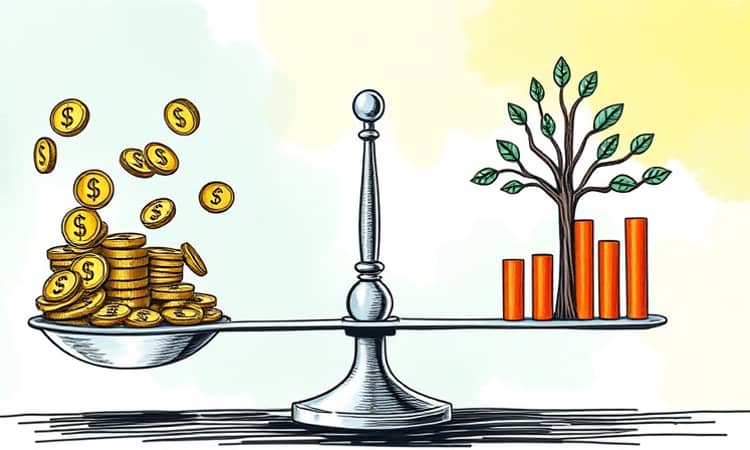
Every investor faces a crucial choice: should you collect dividends as cash today, or plow them back into your holdings for amplified growth tomorrow? This question pits current income against maximum long-term growth, and the right answer depends on your goals, taxes, risk tolerance, and stage of life.
Understanding Dividends and Reinvestment
A dividend is simply a cash distribution from a company’s profits to its shareholders. When you divide the annual dividend per share by the share price, you get the dividend yield. For example, a $3 dividend on a $100 stock yields 3%.
Investors then decide whether to take that cash or participate in a dividend reinvestment plan (DRIP). Reinvesting dividends means using payouts to buy more of the same security automatically, often with zero fees or fractional shares. Alternatively, you can take cash dividends to cover living expenses or redeploy into other assets.
Quantifying the Trade-Off
Consider a simple scenario: you invest $10,000 in a stock yielding 5%. If you take cash, you receive $500 per year, and your principal remains $10,000 indefinitely. No compounding occurs, and your income stream stays flat.
By contrast, reinvesting those dividends can unleash compounding. After year one, you reinvest $500 into your 5% stock, bringing your total holding to $10,500. In year two, a 5% yield on $10,500 generates $525, and so on. Over time, your income stream grows along with your principal.
Mathematically, if P is your initial amount, r is the dividend yield, and n is the number of years, your future value is:
Future value = P × (1 + r)n
A quick illustration:
By year 20, reinvestment more than doubles your value, while taking cash leaves your capital stagnant.
Behavioral and Risk Considerations
Beyond numbers, human psychology plays a big role. DRIPs function as a forced saving plan—you never see the cash, so you’re less tempted to spend it. Automated purchases create a set-and-forget investment habit that smooths out decision-making during market volatility.
Yet reinvestment carries risks. Automatic purchases can lead to over-concentration in a single company or sector, drifting away from your target diversification. Blindly buying into a deteriorating business or at market peaks can drag your portfolio down.
- Compounding growth engine: Dividends buy more shares, generating even larger payouts over decades.
- Low-cost automation: Many brokers offer zero-fee DRIPs and fractional share purchases.
- Dollar-cost averaging: Reinvest at varying market levels, reducing lump-sum timing risk.
- Behavioral discipline: Hides cash from spending impulses and enforces a long-term mindset.
- Lack of diversification: Concentrates reinvestments into the same asset.
- Valuation blind spots: Buys regardless of market price or fundamentals.
- Timing loss: Purchases occur solely at dividend payment dates without investor input.
- No immediate income: Reinvesting forfeits cash flow needed for living expenses.
- Tax tracking complexity: Each reinvestment adds a new lot for cost-basis reporting.
Tax Implications and Record-Keeping
Dividends are taxable in the year they’re paid, even if you reinvest them. That means you owe taxes on phantom cash that you never pocketed. Over time, each reinvestment creates its own tax lot, complicating your records when you sell shares.
Some investors prefer companies that buy back shares instead of paying dividends, since buybacks may defer taxes until you realize a capital gain. Others use tax-advantaged accounts, like IRAs or 401(k)s, to mitigate the drag of annual taxation on reinvested dividends.
Life Stage and Financial Goals
Your personal timeline shapes the optimal choice. If you’re decades away from retirement, long-term compounding can generate powerful wealth accumulation. A younger investor can afford to surrender short-term income for a future windfall.
Conversely, retirees often need reliable cash to cover expenses. For them, a flat dividend stream can provide predictable income without forced reinvestment. Someone saving for a down payment or tuition may also prefer to receive cash to meet a known near-term cost.
- Regular cash flow funds living costs and supplements salary.
- Portfolio rebalancing: Allows spreading dividends across different sectors or asset classes.
- Timing flexibility: Redeploy cash when valuations look attractive.
Making Your Choice
There’s no one-size-fits-all answer. Begin by clarifying your objectives: Are you building generational wealth or funding the next decade’s expenses? Assess your risk tolerance—do you tolerate portfolio concentration or need broader diversification?
Evaluate your tax situation: will annual dividend taxes be prohibitive, or can you house your strategy inside tax-advantaged accounts? Factor in behavioral traits—do you need automation to stay disciplined, or will you actively manage your payouts?
Finally, remember that strategies can evolve. You might reinvest dividends in your early career, then transition to cash payouts as retirement approaches. Or you could adopt a hybrid approach: reinvest a portion and take the rest in cash to balance growth with liquidity.
Conclusion
The dividend dilemma is not a permanent fork in the road but a strategic lever you can adjust over time. By quantifying the compounding effects, acknowledging behavioral biases, and aligning with your life stage, you can craft a plan that balances today’s income needs with tomorrow’s growth potential. Ultimately, the right blend of reinvestment and cash payouts will guide you toward your unique financial goals.