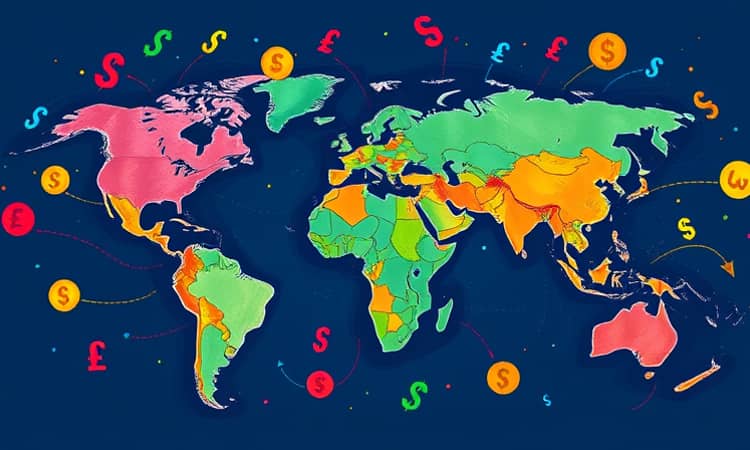
The foreign exchange market stands as one of the most dynamic and influential arenas in the global economy. Every day, trillions of dollars change hands as traders, investors, corporations, and governments seek to buy or sell currencies. Understanding the underlying mechanics of these movements is essential for anyone exposed to international trade, investment, or travel. In this article, we explore the core principles of forex fluctuations, examine the drivers behind exchange rate movements, identify different currency types, and provide practical guidance for individuals and businesses navigating this ever-shifting landscape.
Foundations of Forex Fluctuations
At its heart, the forex market is simply a global marketplace where currencies are exchanged around the clock across major financial centers such as London, New York, and Tokyo. In a floating exchange rate system, the price of one currency in terms of another is continuously determined by market forces of supply and demand. These rates adjust in real time as participants react to new information, economic data releases, and evolving expectations.
Currency fluctuations refer to the ongoing changes in the exchange rate between two currencies over time. Unlike fixed or pegged regimes—where central banks intervene to maintain rates within a narrow band—floating regimes allow rates to move freely. Occasional interventions or policy shifts can still cause abrupt swings, but on most days, the interplay of trade flows, capital flows, and investor psychology sets the pace.
Economic and Policy Drivers
Exchange rates do not move at random. They respond to fundamental indicators, official policies, and sometimes sweeping geopolitical events. These influences can be grouped into three broad categories: fundamental economic factors, policy decisions and institutional frameworks, and sentiment-driven reactions to global events.
- Fundamental Economic Factors
Interest rate differentials between two countries often play a leading role. Higher rates tend to attract yield-seeking capital, boosting demand for the currency, while lower rates encourage outflows. Inflation trends, employment data, GDP growth, and trade balances also shape perceptions of a currency’s relative strength or weakness. - Policy and Institutional Factors
Central bank decisions on rate hikes or cuts, quantitative easing measures, and forward guidance can trigger sharp moves. In managed regimes, authorities may buy or sell reserves to defend a peg, sometimes leading to dramatic realignments when pegs break. - Sentiment and Geopolitical Factors
Political stability, election outcomes, trade disputes, natural disasters, or armed conflict can prompt investors to seek safe-haven assets, often driving up currencies like the USD, JPY, or CHF during global risk-off episodes.
Types of Currencies and Volatility Profiles
Not all currencies behave alike. Liquidity, economic diversity, and policy frameworks determine how sharply a currency reacts to changing conditions. By classifying currencies into major, emerging, commodity, and safe-haven categories, traders gain insight into typical volatility patterns.
Major pairs benefit from massive trading volumes and deep order books, resulting in tighter spreads and relatively lower daily swings. Emerging market currencies often face heightened political risk, lower foreign reserves, and regulatory interventions, leading to more pronounced moves. Commodity currencies correlate strongly with global commodity prices—when oil or metals rally, CAD and AUD frequently appreciate. During periods of uncertainty, safe-haven currencies tend to outperform as investors seek capital preservation.
Measuring Volatility and Practical Responses
Quantifying exchange rate fluctuations is crucial for risk management and strategy development. Traders rely on several tools to measure market turbulence, calibrate position sizes, and set realistic profit targets or stop-loss levels.
- Statistical Measures
Historical volatility, calculated as the standard deviation of returns over a specified period, offers a clear metric of past price dispersion. A higher figure indicates larger average swings, signaling greater risk. - Technical Indicators
Bollinger Bands use a moving average with upper and lower bands set at multiples of standard deviation. Bands widening or narrowing visually illustrate volatility shifts. Average True Range (ATR) measures the average distance between high and low prices, providing another volatility gauge.
Armed with these measures, individuals and businesses can tailor their responses to minimize adverse effects and seize opportunities. Practical strategies include:
- Hedging and Forward Contracts
Businesses can lock in exchange rates for future transactions, protecting profit margins against unfavorable moves. - Diversified Currency Exposure
Investors may spread risk by holding a basket of currencies or using currency-hedged funds to smooth volatility impacts. - Dynamic Position Sizing
Traders can adjust the size of their positions based on measured volatility, reducing exposure when markets become choppy. - Stress Testing and Scenario Planning
Firms can model extreme events—such as a sudden central bank announcement or geopolitical shock—and evaluate potential losses under various rate scenarios.
Concluding Thoughts
Forex fluctuations are the natural outcome of a complex web of economic realities, policy choices, and human psychology. While they can seem daunting, a structured approach to understanding drivers, measuring volatility, and implementing risk management tools empowers both individuals and organizations to navigate these movements confidently.
By appreciating the interplay of trade and capital flows, monitoring central bank signals, and responding with disciplined strategies, market participants can transform the volatility that once appeared threatening into a source of opportunity. In the ongoing "Currency Chronicles," informed awareness remains the most valuable asset.